Videos
These are portions of the home movies of Hugh and Oneta Sanders. The original 8mm film footage was probably taken about 1955-62, mostly on the land they farmed near Brice, Texas. Several years ago, I digitally enhanced them and put the footage in more or less chronological order and preserved them in digital format.
8mm Film – Resolution, Clarity, and Cost
8mm film had low resolution by modern standards—but high intentionality. Its technical specifications include a frame size of 4.8 × 3.5 mm (8mm refers to the entire film width, which include the holes for sprockets to move the film across the lens), and the exposure: was 1/16 of a second. It required a manual aperture adjustment for lighting conditions and there was no instant feedback. Film cost money, and there was a delay to see the results, as it had to be sent away for processing. Every foot of film mattered.
What we see; now—grain, blur, washed highlights—is not failure. It is magnification beyond design. These films were meant to be projected small on a screen from a projector, experienced collectively, and remembered emotionally. We cannot expect 8mm to perform like 4K still photography. It cannot—and should not.
Clarity does not equal Resolution
Resolution is technical detail. Clarity is recognition. These 8mm films succeed at clarity. You know who that is, you know where you are, and you know what matters.
Why the Frames Look the Way They Do
The combination of short exposure and hand-held camera led to motion blur. Manual aperture guesses and and adjustments led to blown highlights or deep shadow. The small negative enlarged many times leads to visible grain. Aging film stock led to color shifts and contrast loss. None of this is error. It is evidence that film was precious, memory was selective, and attention was deliberate.
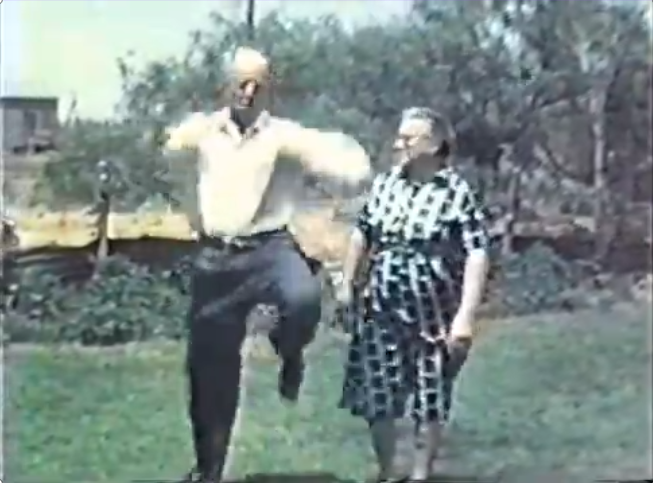
Any time I watch these, I am in awe and appreciation of those who came before. The audio commentary is from family members watching the video on different occasions. They were unaware they were being recorded, and it provides a wonderful narrative and background to the video.
Watching these today
I often say that “we stand on the backs of the giants who came before us”, and then I question “how do we want to live into that as a future?” We’re not standing on their backs —we’re standing in their posture. That showed up as how they showed up for neighbors, how they absorbed risk, how they shared burden, and how they accepted limits without surrender. Those are not abstract virtues. They are embodied choices. The giants we speak of weren’t towering because they dominated. They were giants because they carried weight together — and left behind footholds instead of monuments.
“How do we want to live into that as a future?” That question is not answered by better technology, higher resolution, or faster systems. It is answered by where we place trust, how we distribute responsibility, and whether we leave room for human anchors. Progress isn’t about removing humans from the system. It’s about keeping humans visible within it.
What the Film Remembers
8mm film does not capture the world.
It captures permission.
Permission to remember only what mattered enough to be filmed.
A hand on a shoulder.
A bridge before it was gone.
Children crossing water because there was no other way.
The blur is not absence.
It is mercy.
The grain is not noise.
It is time, showing itself.
Every frame cost money.
Every second required waiting.
So the camera was lifted only when life said: This.
Next dirt roads to travel:
YouTube videos of unusual occurrences in the Panhandle
Channel 1 – The Unusual
YouTube videos of irrigation.
Channel 2 – Irrigation
Daily Life – Maybe these activities didn’t happen every day, but they were typical tasks. Some varied by the time of year, and some were truly everyday occurrences.
Channel 3 – Daily Life