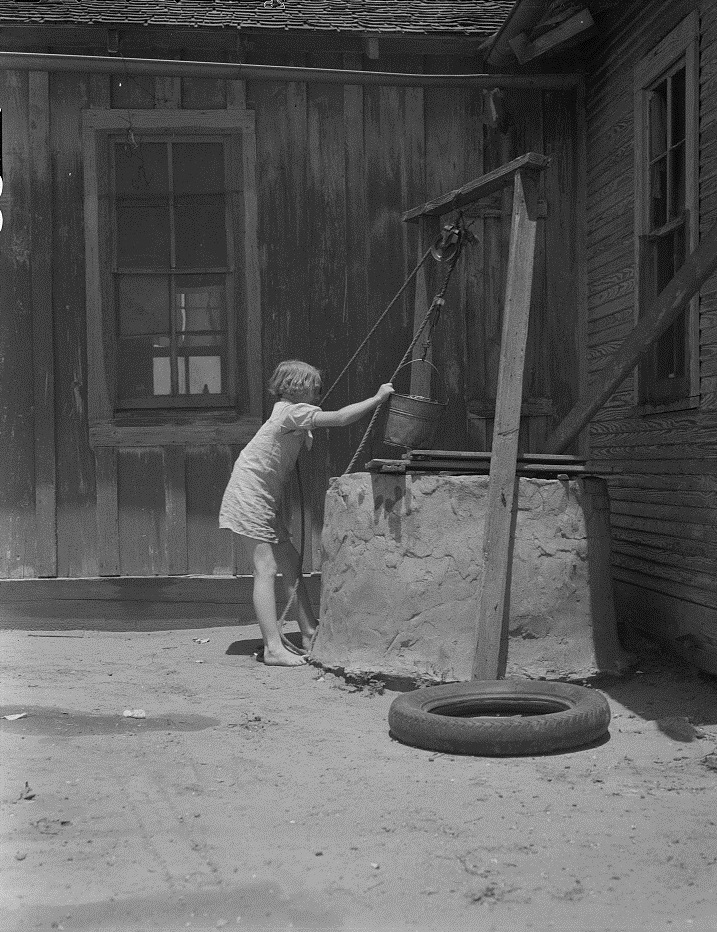
Water, With Hands
Water arrived by effort.
It did not come to the house; it was invited, persuaded, lifted.
Outside the bedroom window stood the cistern—
half door, weathered hinge,
the lower panel always shut,
the upper opening just wide enough for a body to lean into trust.
A rope. A pulley. A bucket that knew its own weight.
Sometimes the water shimmered wrong.
Too alive.
Mosquito larvae traced commas on the surface,
each movement a reminder that water is never neutral.
A thin sheen of kerosene—carefully poured,
not to poison the water,
but to interrupt the breathing of what did not belong.
Wait.
Watch.
Stillness return.
Scoop the evidence away.
This was drinking water.
This was guarded water.
Separate from the stock water—
the hauled water for baths and laundry,
the water that could be used up without regret.
Occasionally, a boy was lowered into the cistern,
feet dangling into cold shadow,
hands scraping silt and forgotten things from the bottom.
A descent into the family’s reservoir of faith:
Clean it now so we can trust it later.
Water taught early lessons.
That purity is maintained, not assumed.
That effort precedes comfort.
That survival is often quiet, repetitive work.
Water was heated on the stove.
Mixed by hand until it felt right.
Poured into an oval aluminum tub.
Baths followed an order that made sense without explanation:
cleanest first,
dirtiest last.
Water remembers what passes through it.
Laundry followed the same logic—
wash tub, rinse tub,
clothes lifted heavy with promise,
then handed to the wind on a line stretched between posts.
Sun and air finished what hands began.
Water was crossed.
Before the bridge was gone, it carried weight—
a quarter mile of wood, one lane, no rails,
hovering above a river that pretended to be harmless until it wasn’t.
After the bridge washed away, water became a meeting place.
Cars parked on opposite banks.
A phone call—when the line worked.
We’ll meet you there.
People walked across what remained,
or through what could be crossed,
business and affection carried by feet instead of wheels.
The river did not stop connection.
It redefined it.
Water separated—and therefore taught intention.
Water was feared.
Floods erased bridges.
Cisterns hid dangers.
Diseases waited in animals that drank where others had died.
Even silence could mean something had gone wrong.
And still—
water was trusted.
Because it had to be.
Water was shared.
Measured in buckets,
timed by chores,
heated for children and elders,
saved for tomorrow because tomorrow was never guaranteed rain.
It moved through hands, through ropes, through pipes,
through fields and across stories,
through memory now.
What remains is not just the water,
but the way it shaped lives:
taught patience,
forced cooperation,
made every crossing conscious.
This is how a place remembers itself—
not by buildings that vanished,
but by water that was hauled,
heated,
crossed,
feared,
and always—
shared.
Next dirt roads to travel:
Lyrical essays are an intentional contrast to analytical essays. Lyrical essays border on poetry. However, the intention is the same; to inform and to encourage thought.
Lyrical Essay
A town is not a point. It is a pattern. Brice was a household. Clarendon was a room. Lakeview was a hallway. Memphis was a door. None sufficient alone. All necessary together.
The Fractal Town
The land did not ask to be conquered. Rows were drawn not as lines of dominance but as agreements with wind and water, with what would grow if given half a chance.
Rows and Rooms