Tractor demonstration, farmers gathered
Dealer demonstration
This is not just about machinery. This is about knowledge transmission. New equipment wasn’t bought sight-unseen; it was demonstrated. Farmers gathered for the demonstration because capital investment was serious and mistakes were costly. With collective evaluation they could reduce risk. This is peer-reviewed agriculture. This is community-centered decision-making.
Before consolidation, before consultants, before agronomists, farmers learned together, evaluated together, and adopted together. This is why Brice and Lakeview still mattered socially even as Clarendon and Memphis grew institutionally.
You’re seeing early adopter dynamics and community as a learning network. This is progress happening in public. Manufacturers/dealers brought new models out and the farms functioned as temporary showrooms. Knowledge spread socially, not through brochures. That’s a very specific mid-century agricultural practice. The dealerships were in Memphis where the equipment was shiny and new. It is apparent that dealers were present in the field, relationships mattered and sales were personal and reputational.
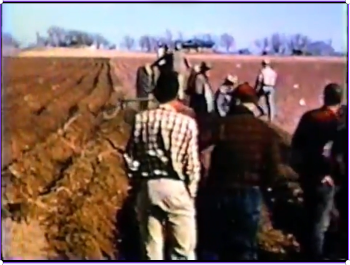
Community gathered behind the plow
That row is a little crooked! Grandpa taught that “his crooked rows would hold more”. That is cultural agronomy, not engineering. It tells us that yield was understood experientially and that straightness was not the highest value. Optimization was local knowledge, not standardized practice.
This shows the transition between dryland and irrigated logic. We see deep tillage, soil standardization, heavy equipment, and increased fuel use. All of this precedes or accompanies irrigation. The land is being asked to become predictable.
No one here is abstracting. Everyone is close to the ground. Everyone understands what they are seeing. This kind of embodied knowledge fades rapidly once fields enlarge, systems automate, and labor specializes.
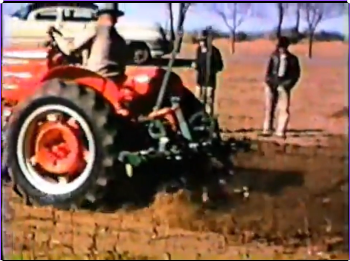
We can see clearly a red tractor (likely Farmall or Allis-Chalmers era, late 1940s–1950s). It has rear-mounted deep tillage equipment actively engaging soil and observers standing off to the side, watching soil turnover. The soil is dry but workable — not muddy, not powder-dry.
This tells us that this is likely post-harvest deep plowing, very plausibly after cotton. Deep plowing here serves stalk burial (boll weevil suppression was still a concern), residue incorporation, and moisture management for the next season.
The tractor color and form place this comfortably in the post-WWII mechanization boom, when surplus manufacturing capacity and pent-up demand flooded rural America with new machines. This is the moment when horsepower becomes a social event, not just a tool.
Here there are multiple adult men, dressed in work clothes and hats typical of the 1940s–50s. We can also see deep, straight furrows already cut, people walking behind or alongside the equipment, not merely watching from a distance. In the background, we can see open, flat High Plains horizon with very little tree cover. This tells us this is not routine field work. This is a demonstration or collective evaluation. You can tell that by the density of people relative to the task, their position in the field (close, attentive, aligned with the furrow), and the absence of casual posture.
This shows farmers gathering to see new equipment or a new method. In this era, machinery decisions were expensive, irreversible in the short term and discussed socially, not individually. This is community risk-sharing through observation.
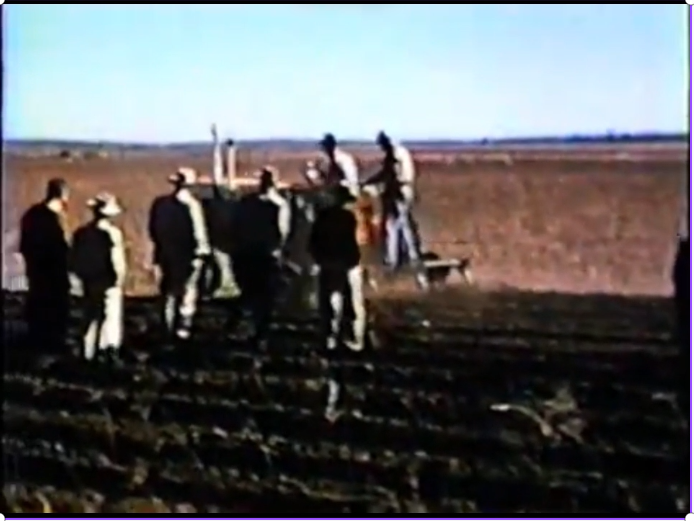
In this picture we can see clearly men grouped in a semicircle around the working end of the implement. One or two operators are elevated on the tractor or implement. There is dust, but not excessive — indicating controlled depth and speed. This tells us that they are not admiring the tractor, they are watching soil behavior. This is farmer science: how deep does it cut? Does it roll or shatter? How uniform is the furrow? How much draft does it require? No pamphlet answers these questions as well as standing in the field.
Next dirt roads to travel:
The eastern Texas Panhandle didn’t support isolated self-sufficiency. Distances were long. Population was thin. Each town specialized — not by planning, but by necessity.
The Interdependence of Brice, Lakeview, Clarendon, and Memphis
Opens on another website — https://fractegrity.com/about-interconnectedness/
About Interconnectedness
This is one of the most culturally important attributed , all pitching in to help a neighbor. “If one of us falls behind, we all fall behind.”
Community Planting for a Sick Neighbor