Hands Turned Inward
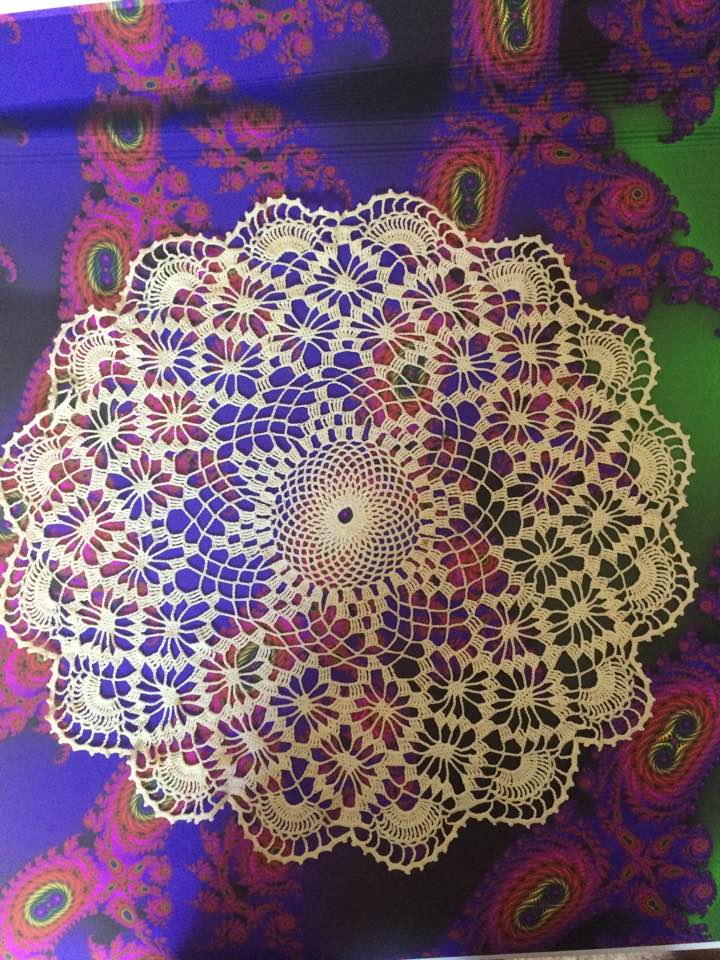
In the slower seasons, when fields slept or waited, hands turned inward. Crochet hooks traced patterns that were not written down. Afghans and doilies grew outward from centers, repeating themselves without ever quite repeating themselves. No one called it mathematics. No one called it art. It was simply what hands did when they remembered how to listen.
Those hands would one day forget. Disease would arrive without metaphor. Dexterity would leave. Memory would loosen its grip. One would lose language first, the other precision. The work of a lifetime would narrow to the work of being cared for.
The Language That Lived in Her Hands
She sits there quietly, eyes lowered, not withdrawn but listening.
The house has settled into its evening shape. The day’s noise has thinned.
What remains is the small, faithful rhythm of hands at work.
Crochet was not a pastime for her. It was a way of being in the world.
Each stitch answered the one before it.
A loop invited a response.
A rule made room for variation.
The work grew outward from a center—never identical, never chaotic—held together by attention.
No paper was needed. No pattern was consulted.
The language lived in her hands.
This was knowledge practiced at human scale:
iterative, forgiving, adaptive.
Mistakes were not failures; they were folded in, absorbed, made part of the whole.
What mattered was not perfection, but coherence—
that the piece would hold.
While fields waited, while men worked soil and weather,
while winters stretched long and evenings exhaled,
domestic labor quietly became design research.
Not abstract. Not named.
But real.
Her hands knew how to wait and when to move on.
They knew when a round was finished, and when it needed one more breath.
They knew how to carry time.
And then, one day, they could not.
Illness arrived without asking permission.
The hands that had spoken so fluently fell silent.
For those who loved her, this was unbearable—not because the work stopped,
but because a language disappeared mid-sentence.
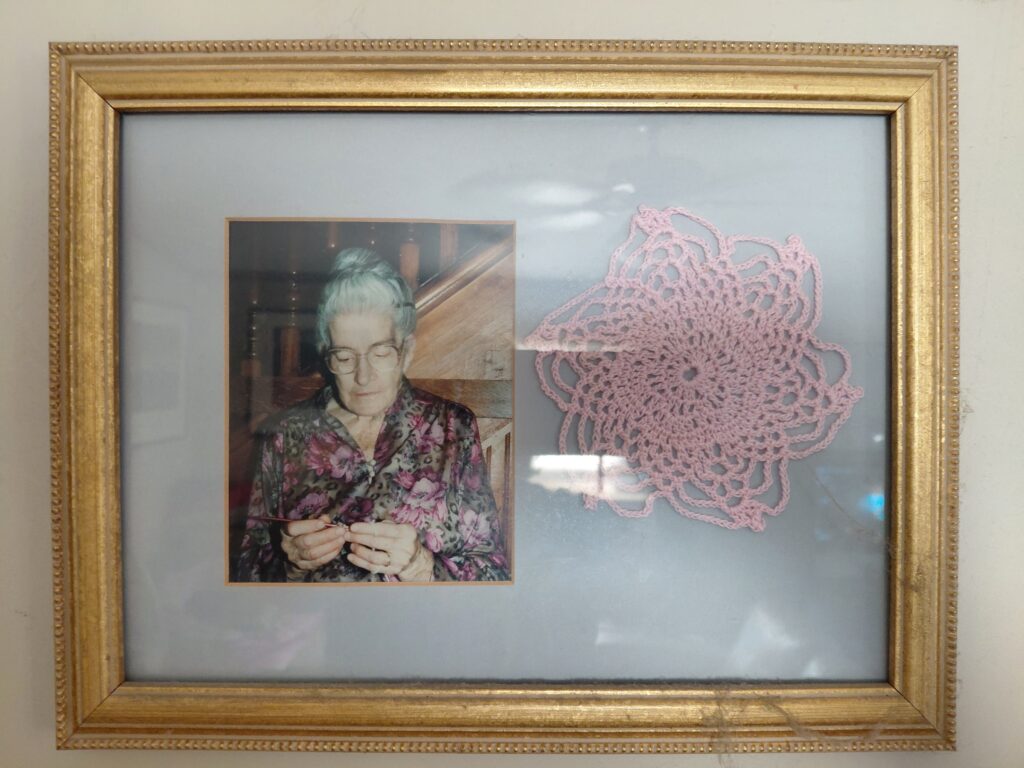
Yet something essential remained.
The blankets still warm.
The doilies still hold their shape.
The patterns she practiced did not vanish when her hands failed.
They were transferred—into rooms, into bodies, into memory.
Her knowing was never confined to her fingers.
It had already been released into the world.
To witness this is to carry a quiet fear forward.
To wonder what happens when the ways we know ourselves begin to loosen.
When hands tremble. When orientation falters.
When the question of care and place must be spoken aloud while there is still time.
But this, too, belongs to the pattern.
What she practiced was not control—it was trust.
Trust that simple moves, repeated with care, create something that endures.
Trust that meaning can be distributed across time.
Trust that even when a stitch is dropped, the fabric can still hold.
She understood fractals without ever naming them.
Understood that the small reflects the large.
That tending what is near prepares what comes later.
That work done with love does not end when the hands must rest.
The language lived in her hands.
And the language—the language is still speaking
Next dirt roads to travel:
Lyrical essays are an intentional contrast to analytical essays. Lyrical essays border on poetry. However, the intention is the same; to inform and to encourage thought.
Lyrical Essay
Before we knew the names of things, we knew how they felt. We called them stickers— goatheads, sand burrs, anything sharp enough to stop a barefoot child mid-stride.
Stickers and Horny Toads
A town is not a point. It is a pattern. Brice was a household. Clarendon was a room. Lakeview was a hallway. Memphis was a door. None sufficient alone. All necessary together.
The Fractal Town