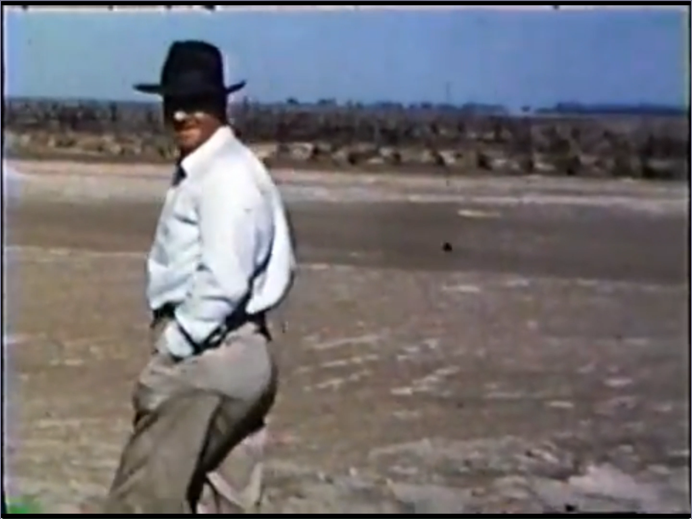
Meeting at the Broken Bridge
After the bridge washed out,
it did not disappear all at once.
It stayed—
in ribs of timber,
in teeth of iron,
in a memory of where crossing used to be possible.
1951, or close enough that the number doesn’t matter.
What mattered was that wheels stopped where feet continued.
On one side of the river lived your great-grandfather,
still “Brice” by mail,
still Antelope Flat by body and breath.
On the other side lived family, errands, town, and time.
The address stayed put.
The river did not.
When the bridge failed, it didn’t end visiting.
It revised it.
Cars came as far as they could.
Engines cooled.
Doors opened.
People stepped out into weather and distance.
If the phone worked—and sometimes it did—
a call went through crackle and luck:
We’re coming over.
Meet us at the bridge.
That word did the work the bridge no longer could.
They parked on their side.
Granddad parked on his.
And between them was the river,
reduced—by drought, by season, by familiarity—
to something a person could walk.
Children crossed first.
They always do.
Feet learned the stones.
Hands reached for balance.
The river was not an obstacle;
it was a pause—
a shared inconvenience that taught patience.
Business was conducted standing up.
News was exchanged with coats still on.
Laughter crossed more easily than freight ever had.
Sometimes the phone was down.
Sometimes it shorted out in weather or time.
Then the bridge had to be trusted in a different way—
as a place someone might be
because it had always been a place someone went.
So they showed up anyway.
This is how infrastructure degrades in human memory:
not as failure,
but as adaptation.
The bridge did not vanish.
It thinned into ritual.
A meeting point instead of a passage.
A promise instead of a convenience.
And the river learned to listen—
to voices calling across it,
to footsteps that knew exactly where to land,
to the quiet understanding that
we will meet you as close as we can
is sometimes the most faithful sentence people can offer each other.
No monument marks this arrangement.
No sign records it.
But it happened.
And because it happened,
the bridge—broken though it was—
still did what bridges are meant to do.
It connected.
Next dirt roads to travel:
Lyrical essays are an intentional contrast to analytical essays. Lyrical essays border on poetry. However, the intention is the same; to inform and to encourage thought.
Lyrical Essay
The land did not ask to be conquered. Rows were drawn not as lines of dominance but as agreements with wind and water, with what would grow if given half a chance.
Rows and Rooms
There are places that never learned how to stay on a map. They lived instead in directions. Named by distance, memory, and need. 23 miles northeast of Silverton.
23 Miles NE of Silverton