Deep plowing after cotton
About Deep Plowing
Deep plowing after cotton harvest served to bury stalks for pest control, especially boll weevil. It also incorporated residue and to reset the soil surface. This was at a time when cotton was still dominant, soil health was understood practically, not abstractly. It also shows that labor and fuel were being spent now to protect next year, an investment in the future. This is stewardship through work, not policy.
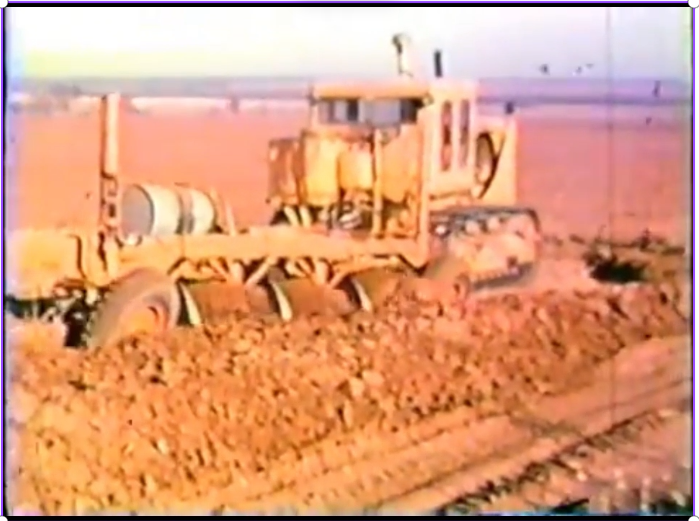
Deep Plowing in Action
This frame shows us a yellow crawler tractor (very likely Caterpillar, mid-century) and large disc plow throwing heavy soil, That’s a deep plow! The wheels keep it at a steady level and control the depth of the plow. Fuel drums were mounted on the implement and the operator was enclosed in a simple cab. This is serious earth-moving agriculture, not garden-variety tillage. Crawler tractors of this size were used when fields were being opened up, land was being reworked, or when soil conditions defeated wheeled tractors. This suggests either conversion of pasture or rough land into cropland or major reconditioning of existing fields. This aligns with the irrigation-era transition, when deeper, more uniform fields became desirable.
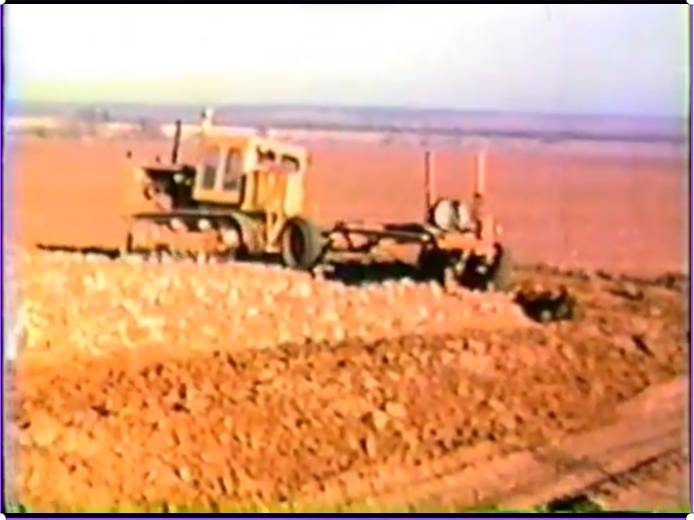
In this image, we can see clearly a long, continuous cut. There is significant soil displacement by the plow. The background is vast and flat with no visible fencing nearby. This tells us that agriculture shifting scale and function. Dryland farming tolerated irregularity while irrigated farming punished it.
Laser leveling comes later — but this is the first step toward geometry: straight lines, uniform depth, predictable flow. This machine is reshaping land not just for crops, but for systems.
Next dirt road to travel:
The CCC was very active across the Panhandle from 1933–1942, including Briscoe, Hall, Donley, and Randall counties. Local work included windbreaks and shelterbelts.
CCC in This Area
The eastern Texas Panhandle didn’t support isolated self-sufficiency. Distances were long. Population was thin. Each town specialized — not by planning, but by necessity.
The Area Commerce
New equipment wasn’t bought sight-unseen; it was demonstrated. Farmers gathered for the demonstration because capital investment was serious and mistakes were costly.
Farm Equipment Demonstrated